
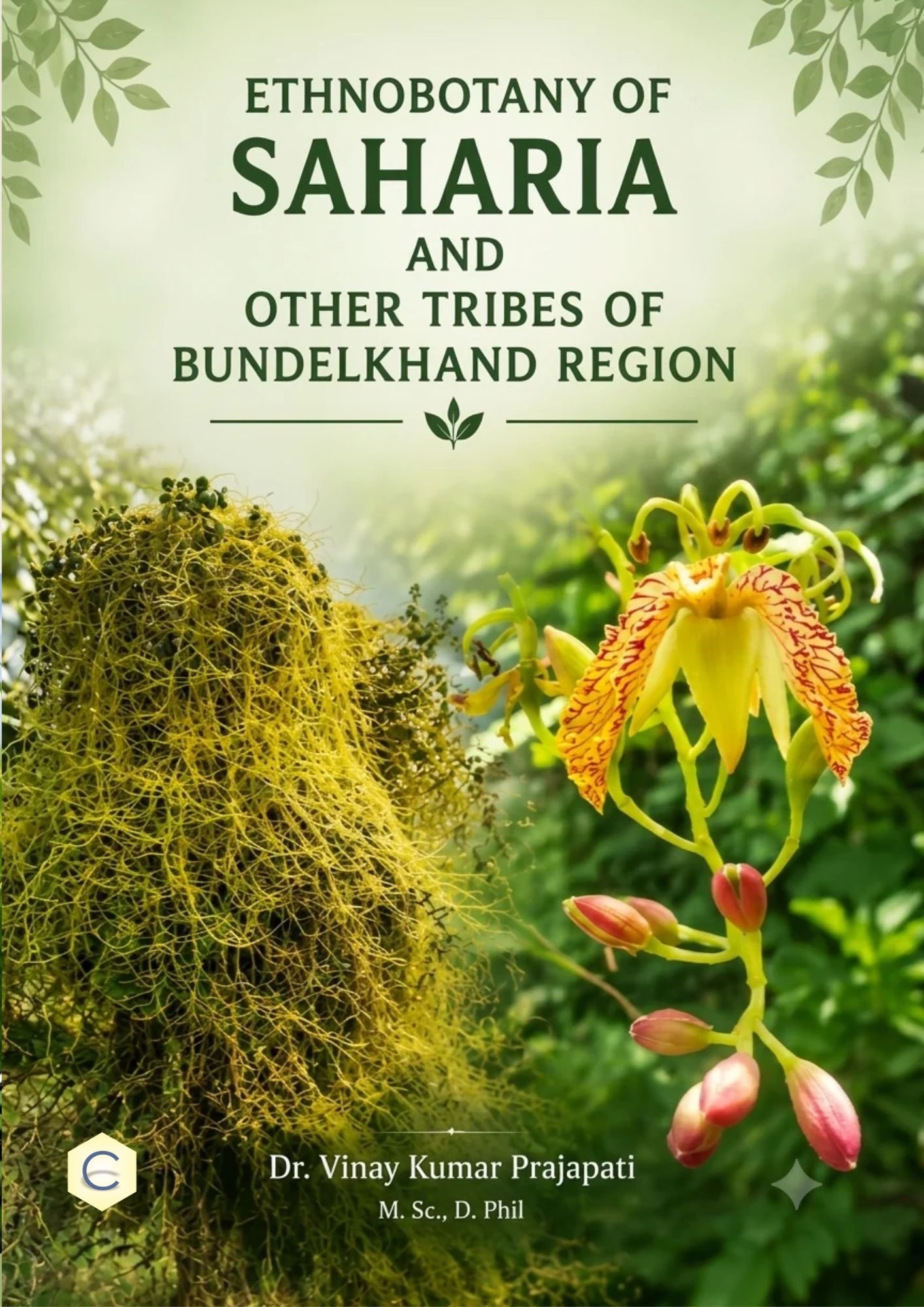
ETHNOBOTANY OF SAHARIA AND OTHER TRIBES OF BUNDELKHAND REGION
AUTHOR -
Dr. VINAY KUMAR PRAJAPATI
Genre/Subject – Eynobotany
ISBN(P) – 978-93-94435-13-1
Publication Date – Dec 2020
Language – English
MRP – INR 399.00

ABOUT AUTHOR
Dr. Vinay Kumar Prajapati, M.Sc. (Botany), Ph.D., is an Assistant Professor in the Department of Botany at Haripur Nihastha Government Degree. College, Raebareli, Uttar Pradesh, India. He is an academician and researcher with expertise in Ethnobotany, Plant Taxonomy, Ecology, Environmental Science, and Biodiversity Conservation. His academic interests encompass plant diversity, traditional knowledge of plant resources, ecological interactions, and the conservation of biodiversity and natural ecosystems.
Dr. Prajapati has contributed to botanical research through the publication of more than 15 research papers in various national and international journals. He has also participated in numerous national and international conferences, providing opportunities for scientific exchange and dissemination of research findings. His scholarly contributions reflect his commitment to advancing knowledge in botanical sciences and promoting research-oriented academic practices.
In addition to his research activities, Dr. Prajapati has guided more than 50 students in their dissertation work, supporting the development of their scientific knowledge, analytical abilities, and research skills. His academic and research endeavors emphasize the importance of botanical studies in understanding plant diversity, ecological sustainability, and environmental conservation. Through his teaching, research, and academic mentorship, he continues to contribute to higher education and the advancement of botanical sciences.
Google scholar ID- https://scholar.google.com/citations?user=_Ik7omEAAAAJ&hl=en

ABOUT BOOK / ABSTRACT
Ethnobotany of Saharia and Other Tribes of Bundelkhand Region is a detailed ethnobotanical study of the traditional knowledge, plant utilization practices and cultural relationship of indigenous and rural communities with the plant resources of the Bundelkhand region of Uttar Pradesh and adjoining areas. Authored by Dr. Vinay Kumar Prajapati, M.Sc., D.Phil., Assistant Professor of Botany, the work presents an extensive field-based investigation centred particularly on Mahoba district and its surrounding regions.
Ethnobotany represents an important interdisciplinary field that examines the relationship between people and plants, including their traditional uses in food, medicine, agriculture, culture and everyday life. The book places this traditional knowledge within a broader scientific framework, discussing the scope and applications of ethnobotany, conservation of plant genetic resources, biodiversity, traditional ecological knowledge and Intellectual Property Rights. It highlights the importance of documenting indigenous knowledge before changing lifestyles and environmental conditions lead to its gradual loss.
A significant portion of the book introduces the geographical and ecological characteristics of Mahoba and the Bundelkhand region. It discusses the area’s topography, soil, climate, rainfall, water resources, forests and vegetation, along with information concerning the local population, languages, social structure and traditional communities. Particular attention is given to the Saharia, Gond and Kol tribes, as well as nomadic and rural communities whose knowledge forms an important foundation of the investigation.
The research is based on extensive field investigations carried out between 1998 and 2001. Various localities of Mahoba district and adjoining areas were visited periodically for the collection and documentation of plants and information concerning their traditional uses. Ethnobotanical information was obtained through interaction with rural inhabitants, tribal communities and nomadic groups. The investigation covered ethno-medicinal, ethno-veterinary, magico-therapeutic, socio-cultural and religious practices, along with insecticidal, pesticidal, narcotic and other uses. Plant specimens were collected, documented, identified and compared with authenticated herbarium material.
The central contribution of the book is its extensive documentation of 252 plant species and approximately 734 ethnotherapeutic and other traditional-use records, including 556 ethno-medicinal, 123 ethno-veterinary and additional magico-therapeutic, socio-cultural and other uses. The study records traditional applications involving different parts of plants—including leaves, roots, bark, stems, fruits, seeds, flowers, bulbs, tubers, rhizomes and whole plants—and documents methods of preparation and application where recorded. The author also identifies 79 pieces of information as new to his knowledge within the investigation.
The book therefore serves not merely as a catalogue of useful plants, but as a record of the interaction between biological resources and traditional communities. It brings together botanical identification, field observation, indigenous knowledge and cultural practices, making it a valuable reference for students, researchers, botanists, ethnobotanists, pharmacognosists, environmental researchers and anyone interested in the traditional knowledge systems of Bundelkhand.
Above all, this work underscores the importance of documenting, conserving and responsibly understanding traditional botanical knowledge while recognizing the ecological and cultural significance of the communities that have preserved and transmitted this knowledge across generations.

